

Early childhood educators
- Early childhood educators and assistants
Plan, organize and lead activities to help children develop intellectually, physically and emotionally. They work with children between the ages of 0 and 12 years in a variety of settings.
On This Page

Full NOC Description
Main Duties
- Early childhood educators perform some or all of the following duties:
- Develop and implement child-care programs that support and promote the physical, cognitive, emotional and social development.
- Lead activities like storytelling, singing, creative arts, dramatic play, and physical activities.
- Plan and maintain safe and healthy environments that prioritize children’s well-being.
- Assess the abilities, interests and needs of children and discuss progress or problems with parents and other staff members.
- Observe and assess children’s development, addressing learning or behavioral issues and communicating progress with parents and staff.
- Guide and assist children in the development of proper eating, dressing and toilet habits.
- Establish collaborative relationships with co-workers and community service providers.
- Assist in implementing child-care programs and activities.
- Engage children through stories, songs, and crafts, while supporting daily routines like eating and resting.
- Help maintain a safe and organized environment, including preparing snacks and setting up activity spaces.
- Provide written observations and assist with record-keeping as needed.
Also Known As
- child care worker assistant
- daycare helper
- daycare supervisor
- daycare worker
- early childhood assistant
Employment Requirements
- Licensing is typically required in most provinces and territories, with specific requirements in Ontario (licensing) and British Columbia (certification).
- Experience in child care may be required.
- Completion of an early childhood education certificate program or post-secondary courses in early childhood education may be required.
- Licensing by a provincial or territorial association as an early childhood educator may also be required.
Provincial Regulation
Not Provincially Regulated
The following graph shows the percentage of men and women working in this occupation in New Brunswick.
Data legend
The following graph shows the breakdown of all persons working in this occupation in New Brunswick by age group.
Data legend
The following graph shows the breakdown of all persons working in this occupation in New Brunswick by highest level of education achieved.
Data legend
The following graph shows the industry groups in which the largest shares of persons working in this occupation in New Brunswick are employed. Small percentages for all top three industry groups may suggest employment for this occupation is widely distributed amongst many industry groups.
Data legend
The following graph shows the breakdown of all persons employed in this occupation in New Brunswick by which economic region they reside in.
Data legend
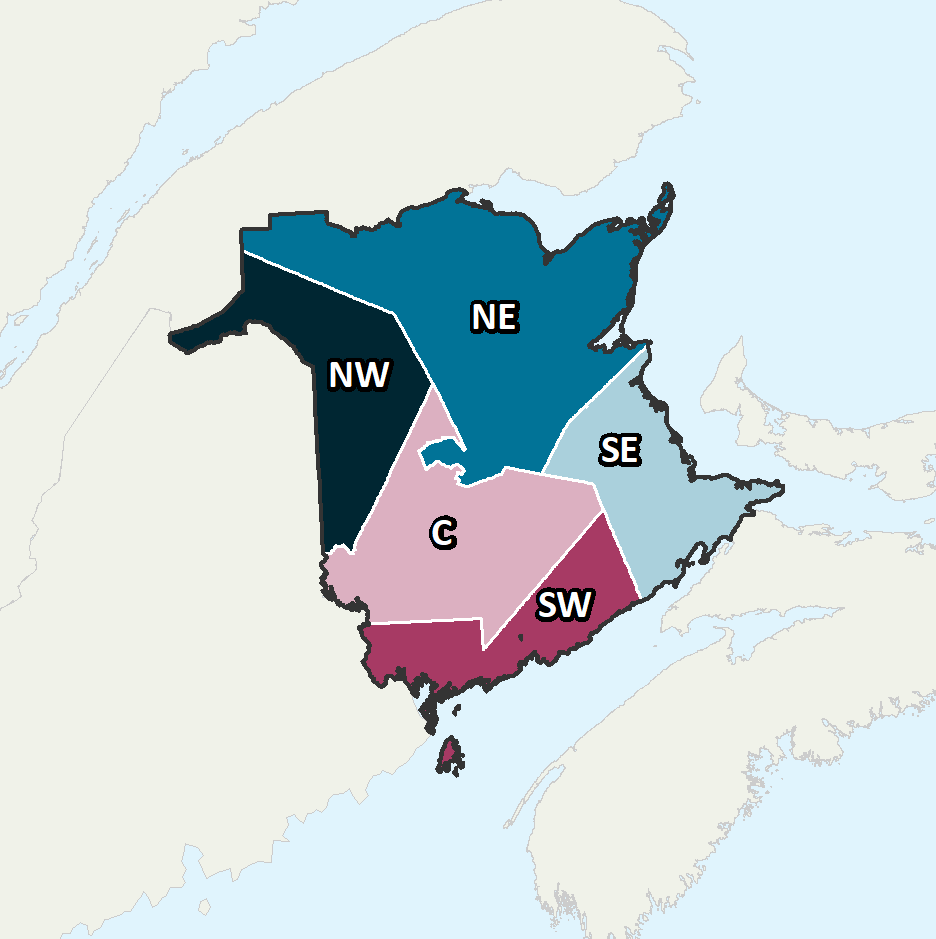
Economic Regions
The following map displays New Brunswick’s five economic regions. An economic region (ER) is a grouping of counties, created as a standard unit for analysis of regional economic activity across Canada.
The following graph shows the average salary of all persons employed in this occupation in each of New Brunswick’s five economic regions.
Data legend
Economic Regions
The following map displays New Brunswick’s five economic regions. An economic region (ER) is a grouping of counties, created as a standard unit for analysis of regional economic activity across Canada.
The following represents the median hourly wage of all persons employed in this occupation in each of New Brunswick’s five economic regions.
The following shows the average salary of everyone who worked full-time and year-round in this occupation across each of the Atlantic Provinces and nationally.
The following represents the number of job openings that are expected to occur in this occupation over the next three and ten years respectively, broken down by openings expected to result from growth (“new jobs”) and openings expected to result from attrition (death and retirements).
Share this page
No endorsement of any products or services is expressed or implied.