

Court reporters, Transcriptionists and related
- Court reporters, medical transcriptionists and related occupations
capture every word in court proceedings and prepare transcripts; transcribe dictation by physicians and other health care providers; transcribe audio for closed captioning and subtitling of video.
On This Page

Full NOC Description
Main Duties
- This group performs some or all of the following duties:
- Court reporters
- Record verbatim proceedings of courtroom using electronic stenograph machine or stenomask
- Respond to requests during court sessions to read back verbatim evidence
- Transcribe recorded proceedings in accordance with established formats
- Verify accuracy of transcripts by checking copy against original record of proceedings and accuracy of rulings by checking with judge
- Research and locate quotes to ensure accuracy
- Respond to requests for transcripts ordered by judges, lawyers or the public
- File and store shorthand notes of court session.
- Medical transcriptionists
- Transcribe recorded dictation in accordance with established formats or written documentation from medical reports, correspondence, health records and patient information
- Proofread work for typographical and grammatical errors
- Edit transcripts for missing or incorrect content and formatting.
Also Known As
- braille technician
- closed captioner
- court reporter
- Hansard reporter
- medical transcriptionist
Employment Requirements
- Court reporters require completion of secondary school.
- Completion of a college or other program in court reporting is usually required and the Chartered Shorthand Reporter (CSR) certificate may be required for court reporters.
- Medical transcriptionists require completion of secondary school.
- Completion of a recognized medical transcription program is usually required and the Certified Medical Transcriptionist (CMT) certificate may be required for medical transcriptors.
- Occupations working in Braille usually require education in Unified English Braille (UEB) competence and related studies of 1-2 years.
Provincial Regulation
Not Provincially Regulated
The following graph shows the percentage of men and women working in this occupation in New Brunswick.
Data legend
The following graph shows the breakdown of all persons working in this occupation in New Brunswick by age group.
Data legend
The following graph shows the breakdown of all persons working in this occupation in New Brunswick by highest level of education achieved.
Data legend
The following graph shows the industry groups in which the largest shares of persons working in this occupation in New Brunswick are employed. Small percentages for all top three industry groups may suggest employment for this occupation is widely distributed amongst many industry groups.
Data legend
The following graph shows the breakdown of all persons employed in this occupation in New Brunswick by which economic region they reside in.
Data legend
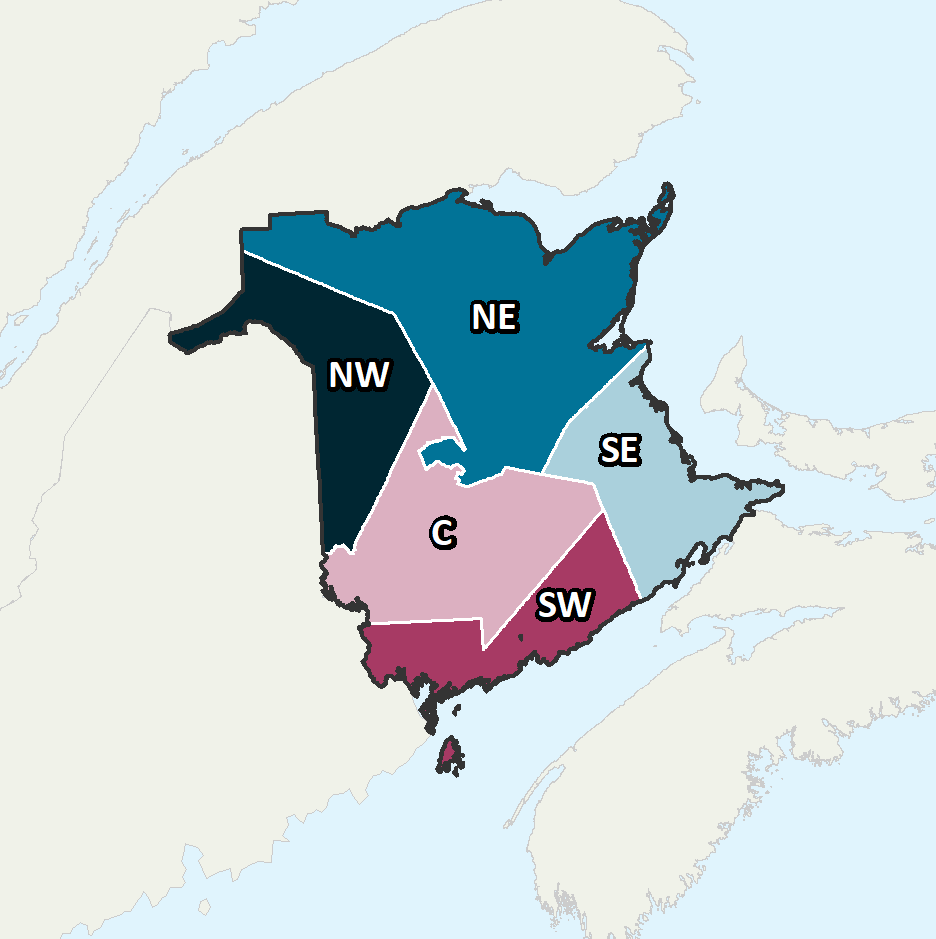
Economic Regions
The following map displays New Brunswick’s five economic regions. An economic region (ER) is a grouping of counties, created as a standard unit for analysis of regional economic activity across Canada.
The following graph shows the average salary of all persons employed in this occupation in each of New Brunswick’s five economic regions.
Data legend
Economic Regions
The following map displays New Brunswick’s five economic regions. An economic region (ER) is a grouping of counties, created as a standard unit for analysis of regional economic activity across Canada.
The following represents the median hourly wage of all persons employed in this occupation in each of New Brunswick’s five economic regions.
The following shows the average salary of everyone who worked full-time and year-round in this occupation across each of the Atlantic Provinces and nationally.
The following represents the number of job openings that are expected to occur in this occupation over the next three and ten years respectively, broken down by openings expected to result from growth (“new jobs”) and openings expected to result from attrition (death and retirements).
Share this page
No endorsement of any products or services is expressed or implied.